

Foundation cracks in Ohio rarely appear without context. They are usually the result of environmental patterns that repeat year after year. In Dayton, one of the most influential forces acting on concrete foundations is the freeze-thaw cycle. While it may seem like normal seasonal weather, the repeated expansion and contraction of moisture inside and around concrete slowly changes how foundations behave.
When homeowners begin researching why cracks seem to appear after winter, many eventually visit their website to better understand whether what they are seeing requires foundation crack repair or simple observation. In climates like Dayton’s, the answer often depends less on the size of the crack and more on how the concrete has responded to seasonal stress.
How Freeze-Thaw Pressure Builds Inside Concrete
Concrete is durable, but it is not completely impermeable. Tiny pores and microscopic openings allow moisture to enter over time. During warmer months, this moisture may not cause visible issues. However, when temperatures drop below freezing, water inside those pores expands.
That expansion creates internal pressure. When temperatures rise, the water contracts again. Each cycle places stress on the surrounding concrete.
In Dayton, where temperatures frequently move above and below freezing within short periods, this process repeats multiple times during a single winter. Over several seasons, this stress can turn minor imperfections into visible cracks.
Why Cracks Often Appear In Early Spring
Many homeowners report noticing foundation cracks in late winter or early spring. The timing is not random.
During winter, freeze-thaw cycles quietly stress the foundation. Snow accumulation increases ground moisture. When temperatures rise and the soil begins to thaw, pressure shifts again.
Cracks that were forming internally during colder months often become more visible once temperatures stabilize. The concrete may not have failed suddenly. It may have been responding gradually to months of pressure.
The Role Of Soil Expansion In Dayton
Dayton’s soil composition contributes additional movement. Certain clay-based soils expand significantly when saturated with water and shrink during dry periods.
When snow melts or heavy rain occurs, saturated soil pushes outward against foundation walls. During dry spells, the soil contracts and pulls away, reducing support in certain areas.
This combination of external soil pressure and internal freeze expansion creates a complex stress pattern. Foundation crack repair in this region often involves evaluating both soil conditions and concrete behavior.
Why Crack Direction Matters In Cold Climates
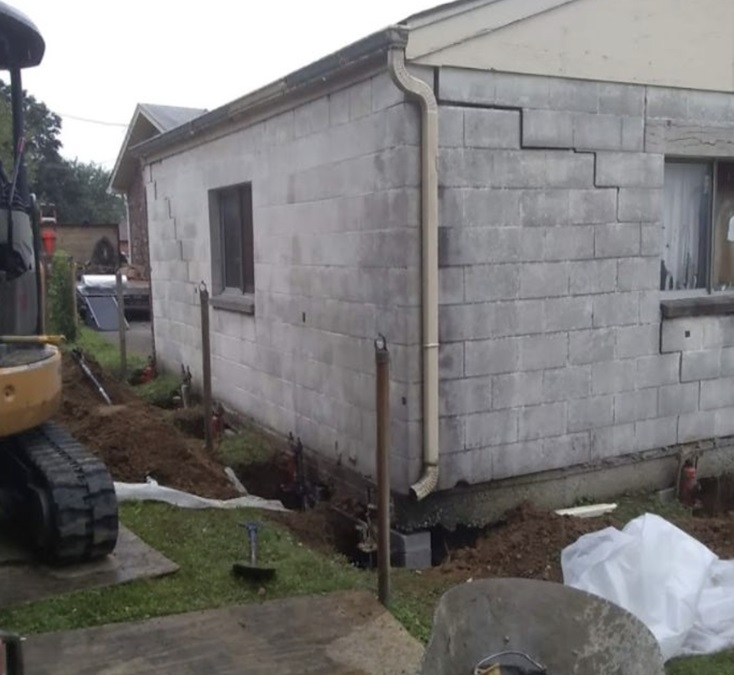
Not all cracks form in the same way. Vertical cracks often indicate settlement or temperature-related contraction. Stair-step cracks in masonry blocks may signal uneven soil pressure. Horizontal cracks are more commonly associated with lateral force from expanding soil.
Understanding crack direction helps determine whether the issue is surface-level or structural.
In freeze-thaw regions, repeated horizontal stress can gradually weaken basement walls if moisture management is poor.
The Connection Between Moisture And Structural Movement
Water is central to freeze-thaw damage. Poor drainage allows moisture to accumulate near the foundation. Downspouts that discharge too close to the home increase saturation. Improper grading directs rainwater toward the structure rather than away from it.
When concrete remains consistently exposed to moisture, freeze expansion becomes more aggressive. Foundation crack repair often goes hand in hand with drainage improvements.
Addressing moisture sources reduces the likelihood of recurring crack formation.
Why Some Cracks Stay Cosmetic
Not every crack caused by freeze-thaw cycles is structural. Surface shrinkage cracks may remain stable for years.
The key difference lies in progression. If cracks remain narrow and unchanged across seasons, they are often cosmetic. If they widen, extend, or multiply, structural movement may be present.
Monitoring changes through seasonal cycles provides valuable insight.
When Interior Symptoms Begin Appearing
Foundation movement does not always remain confined to basement walls. As cracks expand, subtle interior changes may appear.
Doors may begin sticking. Windows may feel misaligned. Drywall cracks may form upstairs. Floors may develop slight slopes.
These signs often develop gradually. When multiple symptoms appear together, they suggest that freeze-thaw stress has influenced structural alignment.
At that point, foundation crack repair becomes less about sealing a crack and more about restoring stability.
Why DIY Patching Often Fails In Dayton
Many homeowners attempt to patch cracks themselves. For surface-level issues, this may provide temporary improvement.
However, in climates affected by freeze-thaw cycles, underlying moisture pressure continues. When temperatures drop again, internal expansion reopens patched areas.
Without addressing the root cause, cosmetic repairs rarely last through multiple winter seasons.
Professional evaluation focuses on long-term stability rather than short-term concealment.
The Long-Term Impact Of Repeated Seasonal Stress
Foundations in Dayton are built to withstand environmental change, but repeated seasonal stress accumulates over time.
Each winter adds another freeze-thaw cycle. Each spring shifts soil pressure. Over several years, minor weaknesses can compound.
Foundation crack repair is often preventative as much as corrective. Stabilizing movement early reduces the risk of larger structural adjustments later.
What A Professional Evaluation Considers
A proper assessment goes beyond measuring crack width. It evaluates wall alignment, soil expansion patterns, moisture levels, and overall structural load distribution.
In many cases, homeowners discover that cracks are manageable with targeted repair. In others, stabilization techniques prevent future movement.
The goal is clarity. Knowing whether cracks are cosmetic or structural removes uncertainty.
Conclusion
Freeze-thaw cycles are a normal part of life in Dayton, but their effect on concrete foundations is often misunderstood. What appears to be a simple crack may reflect months of seasonal stress working quietly beneath the surface.
At Dayton Foundation Repair Experts, many homeowners learn that foundation crack repair is not about reacting to isolated damage. It is about understanding how weather, soil, and moisture interact with concrete over time.
When cracks are evaluated within the context of Dayton’s climate, decisions become practical rather than reactive. Stability comes from informed action, not assumption.